
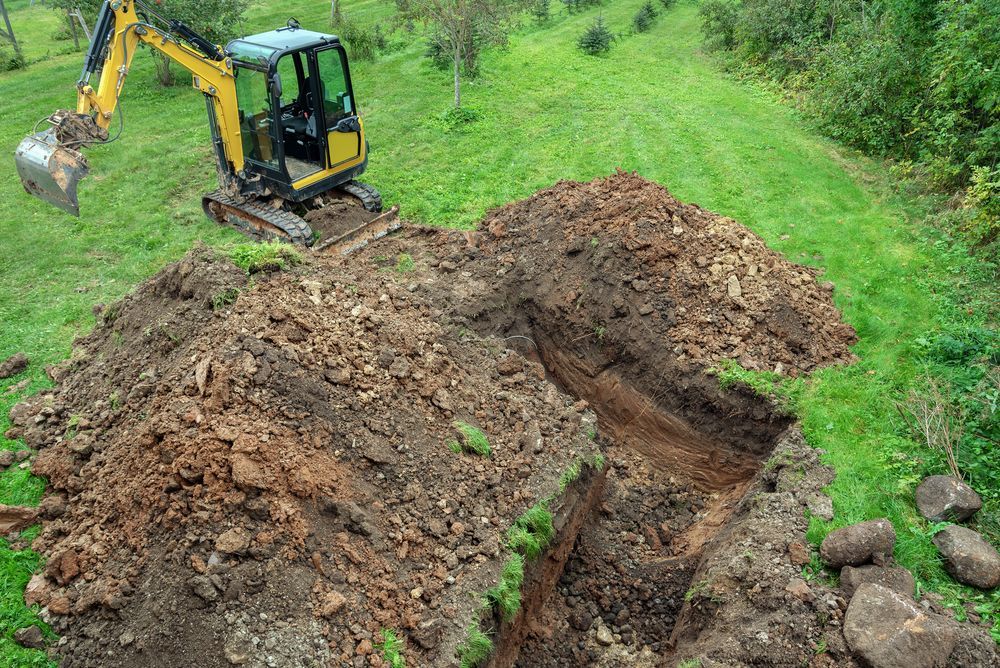
Digging and Earthmoving for Project Foundations
Excavation in Bladenboro for utility trenches, building footings, and drainage lines where precise depth and alignment prevent costly rework
Porter's Landscaping & Land Management provides excavation services across Bladenboro, Whiteville, Lumberton, and surrounding areas, including trenching, earthmoving, and digging for drainage systems, foundations, and utility installation. You need excavation when a project requires controlled removal of soil to exact depths and slopes, when underground lines must be installed without damaging existing infrastructure, or when a building pad must be cut into sloped terrain. The work uses excavators, backhoes, and trenchers to move soil efficiently while maintaining the stability and safety of the surrounding site.
Each excavation project begins with marking underground utilities using locate services, measuring depth and alignment requirements from plans or site stakes, and selecting equipment sized for the scope of work. Trenches are dug with vertical or sloped walls depending on depth and soil type, and excavated material is either stockpiled on-site for backfill or hauled away if excess. Drainage trenches are graded to precise slopes to ensure gravity flow, and foundation excavations are cut to dimensions that allow room for footings and formwork. The bottom of each excavation is checked for level or slope accuracy before proceeding with pipe installation, concrete placement, or other follow-up work.
If your project requires excavation for drainage, utilities, or foundations, contact Porter's Landscaping & Land Management to review the specifications and receive a quote based on the depth, length, and soil conditions involved.
What Excavation Prepares for Your Build or Repair
After excavation, you will see open trenches or pits cut to the required dimensions, with stable walls and clean floors ready for the next phase of installation. Utility trenches are sloped to match pipe grades, foundation excavations are level and free of loose soil, and drainage lines have unobstructed paths that prevent future clogs or standing water. The site remains accessible for equipment, and excavated soil is managed to avoid blocking access or creating mud when it rains. Once backfill is completed, the ground is compacted to prevent settling and restore surface stability.
Porter's Landscaping & Land Management coordinates excavation with other contractors to ensure that digging, installation, and backfill occur in the correct sequence without delays. The service is scaled to handle small residential trenches for sump discharge lines as well as larger commercial excavations for retention ponds or building foundations. Equipment operators are experienced in working around existing structures, trees, and buried infrastructure, minimizing disruption and avoiding damage.
The service includes all digging, soil removal or stockpiling, trench shaping, and initial backfill compaction. It does not include pipe or material supply, concrete work, or final grading and seeding. Utility locates must be completed before excavation begins, and any required permits are the responsibility of the property owner or contractor.
Excavation Questions Clients Frequently Ask
Homeowners and contractors often ask about equipment, trench safety, and how excavation integrates with grading and site prep work.
What size excavator is used for residential foundation work?
A mid-size excavator with a digging depth of twelve to fifteen feet is typical for residential foundations, allowing precise control and access in confined spaces.
How is trench depth verified during digging?
A laser level or grade rod is used to check depth at multiple points along the trench, ensuring the bottom matches the required slope or elevation.
Why must trenches be backfilled in layers?
Backfilling in six-inch lifts and compacting each layer prevents future settling that would cause driveways, walkways, or lawns to sink over the trench line.
What happens if rock is encountered during excavation in Bladenboro?
Rock may require a hydraulic breaker attachment or removal by a specialized contractor, and the additional labor and equipment time will be reflected in project cost and schedule.
When should excavation be scheduled in relation to utility installation?
Excavation should occur immediately before pipe or conduit installation to minimize trench exposure time, reduce cave-in risk, and keep the work area safe and organized.
Porter's Landscaping & Land Management provides excavation that meets project specifications and supports safe, efficient installation of foundations, drainage, and utilities. Call to discuss your excavation needs and schedule the digging work that moves your project forward.